This article provides an overview of operational and strategic levers to make maintenance a driver of sustainable performance, of continuous compliance, and of a controlled user experience.
Key takeaways
- Maintaining multi-occupancy buildings is inherently complex because it involves many stakeholders (owners, facility operators, occupants, and service providers), each with distinct responsibilities, contracts and coordination constraints.
- Safety, service continuity, comfort and regulatory compliance must all be delivered day to day: increasingly technical systems and recurring inspections require structured processes and reliable traceability.
- Data becomes the backbone of effective maintenance management: a CAFM for facility management, strengthened by IoT sensors and mobile tools, helps detect early warning signs, plan interventions more efficiently, and build a digital “asset health record” with full history and documentation.
- Moving from reactive to orchestrated maintenance relies on standardisation (workflows, checklists, work orders), KPI-driven governance and coordinated contractor management—turning maintenance into a strategic lever for performance and occupant experience.
Why is maintenance of collective buildings a complex challenge?
In collective buildings (offices, shopping centers, residential complexes), maintenance is not limited to fixing a failed asset: it takes place in a multi-use environment, with diverse occupant profiles, multiple interfaces, and heightened safety and service requirements.
A multi-stakeholder environment: owners, occupants, contractors, operators
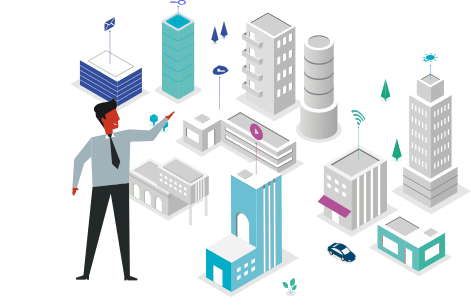
A collective building functions as a “system of interactions” between several stakeholders. The owner or investor, the occupants or tenants (employees, visitors, residents), the building manager/operator, and technical contractors (multi-technical, elevators, HVAC, security) coexist within the same perimeter.
This multiplicity implies:
- different contractual interfaces (operation, maintenance, service contracts)
- precise coordination between occupants and technicians (often with limited working hours)
- shared responsibility depending on the assets.
Demanding environments: safety, comfort, compliance
In an office building or a shopping center, any interruption of activity is costly. In a residential building, occupants’ comfort is at stake. Planning interventions, maintaining continuity of service and ensuring safety therefore become management imperatives.
The increasing technical complexity of installations (heat pumps, double-flow ventilation, fire systems) requires constant vigilance.
This rigorous maintenance helps preserve asset value and regulatory compliance. Periodic inspections (elevators, ventilation, fire safety systems, domestic hot water) require precise, recorded follow-ups.
The CMMS o CAFM enables you to:
- Structure interactions through multisite management: a unified reference (buildings, assets, contractors) and a personalized portal for each participant.
- Automate regulatory alerts and generate the reports needed for audits.
- Benefit from a digital “health record” for each asset, with history, technical documents, interventions, preventive plans and regulatory alerts.

What levers can be used to manage maintenance through data?
Data transforms maintenance: it becomes the engine for decision-making, control and anticipation.
CMMS, IoT and mobility: toward real-time management
CMMS solutions centralize histories, contracts and work orders. When combined with IoT sensors (temperature, vibration, pressure…), they enable anticipating deviations.
For example, a sensor on a refrigeration unit can warn of an imminent failure.
The benefits: fewer outages, better-planned interventions, and a consolidated history.
Digital registers: traceability as an efficiency lever
Digitized regulatory registers (fire, elevators, domestic hot water) simplify audits and make inspections and archiving more reliable. This saves substantial time during inspections.
Indicators and dashboards: turning data into decisions
You need to define the right KPIs to track.
- percentage of preventive vs. corrective maintenance
- availability rate
- maintenance cost per m²
- rate of urgent interventions, etc.
Managing these indicators, sourced from the CMMS, allows you to adjust resources, evaluate contractors and make decisions.
Building maintenance: how to reconcile regulatory safety and occupant satisfaction?
Make safety a collective reflex, not just an audit topic
Safety systems (access control, fire detection, lighting, elevators) must operate continuously, not only during official inspections.
The winning approach :
- Schedule recurring checks
- Raise user awareness
- Value field feedback as indicators of active safety.
Anticipate risks while minimizing disruptions
This requires:
- planning interventions during off-peak hours
- informing occupants in advance
- providing temporary solutions for critical assets.
Well-planned maintenance limits activity interruptions.
How to move from reactive maintenance to orchestrated maintenance?
The maturity of a maintenance setup is measured by its ability to unite, standardize and continuously improve.
Coordinate contractors as an ecosystem
Rather than managing each contractor in isolation, structure a transversal organization :
- centralized management of interventions
- a maintenance manager acting as conductor.
Industrialize performance: standardization, control, continuous improvement
Standardizing work orders and creating checklists ensure intervention quality.
Regular audits and systematic feedback embed a culture of continuous improvement.
What if maintenance became a strategic asset?
A progressive approach is required :
- Map sites, technical lots and contractors.
- Structure processes and centralize requests via a CMMS.
- Manage KPIs and run regular performance reviews.
Over time, this orchestration turns maintenance into a strategic lever: continuity of service, controlled compliance and improved occupant experience.
Maintenance of collective buildings is no longer a mere technical service. It is a living system that links performance, safety and utility value.
By combining coordination, traceability and data-driven management, maintenance managers can transform their organization: more fluid, more reliable, more visible.
Orchestrated maintenance means controlled operations serving the building, its occupants and its longevity.