Sommaire
Every unplanned breakdown costs more than just repair time. A global report by ABB found that 83% of facilities estimate downtime costs at least $10,000 per hour, with 76% putting the figure as high as $500,000 per hour. That is a lot of money to lose to a problem that is often preventable.
Most manufacturers know maintenance matters. But knowing it and acting on it are two different things. Without a clear plan, teams end up reacting to failures instead of stopping them.
That is where industrial maintenance best practices come in. From choosing the right maintenance approach to using a computerized maintenance management system (CMMS), the right strategy turns maintenance from a cost center into a competitive advantage. This guide covers what works, what the data says, and how to put it into practice.
Key Takeaways
- Industrial maintenance ensures equipment availability, secures operations, and supports the quality of finished products.
- Moving beyond corrective maintenance toward preventive and predictive approaches reduces equipment failures and controls maintenance costs.
- CMMS platforms, sensors, data analytics, and machine learning provide real-time visibility, improve operational efficiency, and extend asset lifespan.
- Tracking maintenance performance through key metrics helps teams spot problems early and drive continuous improvement.
- A scalable, user-friendly CMMS aligned with your operational needs is the foundation of an effective maintenance strategy.

What is Industrial Maintenance?
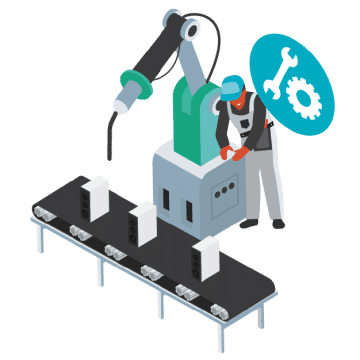
Maintenance means maintaining or restoring equipment so it can perform the service it was built for. This includes replacing minor parts like bulbs, cables, and filters, as well as major overhauls and fine-tuning of machines.
In the industrial sector, it is often necessary to go beyond simple monitoring. Teams must aggregate large amounts of data to guarantee the operation of complex industrial machinery. The accuracy of that data is essential to organizational performance, product quality, and operator safety.
There are three major types of industrial maintenance:
Corrective Maintenance
Corrective maintenance is carried out as soon as a fault is detected. The goal is to quickly bring the equipment back into working order through repair or part replacement. It carries the highest emergency repair costs of the three approaches.
Preventive Maintenance
Preventive maintenance is carried out before any fault occurs. Equipment is regularly checked based on specific criteria or at a set frequency through preventive maintenance schedules. Research shows that this approach can reduce equipment failures by 40-60% and lower maintenance costs by 25-35% compared to reactive approaches.
Predictive Maintenance
Predictive maintenance exploits the full potential of real time data. Using techniques like vibration analysis and oil analysis, data is extrapolated to anticipate faults before they happen. Continuous monitoring of equipment performance improves equipment reliability and helps teams predict failures before they cause downtime. According to Deloitte, predictive maintenance can reduce breakdowns by up to 70% and lower maintenance costs by around 25%.
Why Industrial Maintenance Management Matters for Your Company
Reducing Maintenance Costs
Anticipating faults reduces emergency repair costs, extends equipment lifespan, and minimizes unplanned downtime. It also cuts operational costs such as energy waste from poorly maintained equipment. Reducing unplanned downtime costs and being able to optimize maintenance costs are two of the clearest financial returns from a structured maintenance program. Industry benchmarks show that a well-run maintenance management program can reduce unplanned downtime by 50-75%.
Want to reduce your maintenance costs? Talk to a DimoMaint specialist.
Equipment Safety and Industrial Safety
In the case of complex or dangerous industrial machinery, keeping equipment in good working condition is essential. Equipment safety and operational safety both depend on it. A machine running outside normal parameters puts operators at risk. Maintaining detailed maintenance history for each asset also supports regulatory compliance and workplace safety audits.
Productivity and Equipment Effectiveness
Effective maintenance management prevents costly production downtime and helps better allocate working time. Production efficiency and equipment effectiveness both rise when industrial equipment is consistently maintained. Overall equipment effectiveness (OEE) is the standard measure for this, with world-class facilities targeting 85% or higher.
Quality and Image
The quality of end products depends directly on the quality of equipment. Keeping equipment functional minimizes the likelihood of product defects. Continuous production also has a positive impact on brand image and customer trust.
Equipment deterioration increases the risk of faults and production downtime. Significant costs are at stake, along with the company’s reputation for reliability. Some companies address this through Total Productive Maintenance (TPM), a well-established framework for building a proactive maintenance culture and embedding continuous improvement across equipment, processes, and people.
How Machine Learning and Autonomous Maintenance Are Shaping Industrial Maintenance

New technologies make it possible to go further in planning and anticipation, whatever type of maintenance you have chosen. Electronic sensors, data analytics, and machine learning enable real-time monitoring of each machine through connected monitoring systems. Continuous monitoring helps teams prevent equipment failures and catch unexpected failures before they escalate.
Continuous data collection lets teams track many KPIs and build customized maintenance plans based on each asset’s wear and history. Maintenance technicians can also access work orders and asset data from mobile devices on the floor. This reduces the delay between detecting an issue and acting on it.
Autonomous maintenance is another practice gaining ground. It involves training machine operators to perform basic maintenance tasks such as cleaning, lubrication, and visual inspections on their own equipment. This catches issues earlier and distributes responsibility beyond the maintenance team.
Software solutions such as CMMS offer complete visibility of machine fleets, spare parts inventories, and intervention schedules. They support scheduled maintenance across all assets and reduce the need for costly emergency repairs. CMMS can address most industrial maintenance challenges by:
- Reducing maintenance costs: A full overview of costs, schedules, and maintenance activities enables you to optimize operations, avoid unnecessary interventions, and group purchases to cut associated costs.
- Improving productivity: CMMS makes it possible to estimate repair times (MTTR) and intervention frequency (MTBF), reducing machine downtime.
- Extending equipment lifespan: Equipment lifespan can be extended by 5 to 10% through better, more consistent maintenance.
Industrial Maintenance Best Practices: Critical Equipment, Maintenance Activities, and Optimization
Prioritize critical equipment. Reliability-Centered Maintenance (RCM) focuses resources on the critical assets that drive most downtime or cost, typically the top 10-20% of a fleet. This helps minimize costly downtime while extending asset lifespan across the rest of the operation.
Follow preventive maintenance schedules. Good maintenance scheduling means every planned maintenance task is assigned, tracked, and completed on time. PM compliance rate measures the percentage of scheduled tasks completed. Falling below 85% typically leads to a sharp rise in reactive failures.
Invest in ongoing training. Research shows that structured training can reduce unplanned downtime by 32% in the first year. It also improves first-time fix rates by 40-50%. Standardized operating procedures help maintain consistency as experienced technicians retire.
Use maintenance history to anticipate failures. Every work order, part replacement, and inspection logged in a CMMS builds a record that helps teams predict failures and make smarter repair-vs-replace decisions. This is the foundation of any serious maintenance optimization effort, turning raw data into a repeatable maintenance process.
Foster cross-functional accountability. Good maintenance practices treat maintenance as a shared responsibility across operations, engineering, and leadership. Tools like fault tree analysis help teams find root causes of recurring failures in industrial processes, rather than patching the same faults repeatedly. A culture of shared ownership is what improves operational efficiency at scale.
Want to build a stronger maintenance program? Speak with a DimoMaint specialist.
How to Choose the Right CMMS: Asset Management and Essential Components
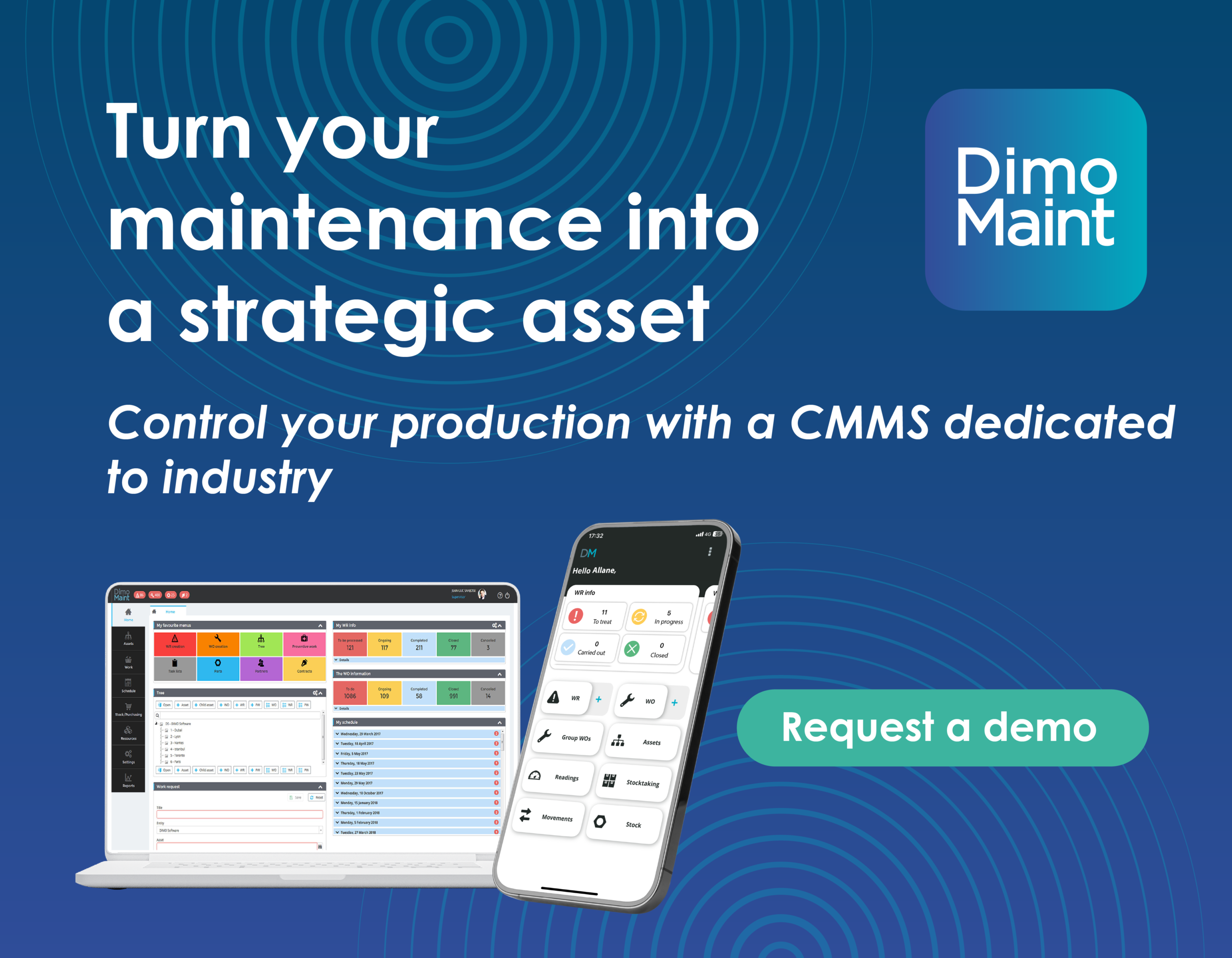
There are several considerations when choosing a CMMS. Traditional solutions offer all the functions needed to monitor a fleet. Enhanced solutions built on newer technologies bring greater mobility and collaboration, and are often available as SaaS platforms accessible by everyone involved in maintenance.
To select software truly adapted to your needs, consider:
- Features: Asset management, service request management, inventory control, planning, costs and budget, and dashboards are essential components of any capable CMMS. Overall equipment effectiveness (OEE) reporting is another key feature to look for. All of these must match your specific activity.
- User experience: The CMMS must be intuitive and easy to learn. If it is not adopted in-house, it will not deliver value.
- Adaptability: Look for easy configuration, scalability, and integration with your existing ERP or digital tools.
- Support and training: Make sure your teams get the support they need to use the tool effectively.
Good CMMS software makes it easy to share data and provides accurate information on equipment condition at all times.
Why Does Your Company Need a Good Industrial Maintenance Strategy?
From managing people to purchasing parts at the right time, CMMS is the best way to keep control of your maintenance operations. New technologies make maintenance more precise than ever. Choosing the right partner means deploying software tailored to your day-to-day needs and your productivity goals.
Who Better to Talk About It Than Our Clients
Using the DimoMaint CMMS tool made us change our procedures. For instance, purchasing used to be done entirely through paperwork. Now, the process is fully-digitalized and we have purchase order numbers, and POs are delivered by mail”.
Dovechem, one of the leading chemical companies in the Asia-Pacific region.
Read the full testimonial from Dovechem
With DimoMaint MX, we know the stock status. The solution is above all much more functional than Excel where you cannot do MRP or set alerts.”
Elkem Silicones, world leader in silicones.
Read the full testimonial from Elkem Silicones
FAQ
What are the different types of industrial maintenance, and why are they important?
There are three main types: preventive, corrective, and predictive. Preventive maintenance plans include regular work to avoid faults. Corrective maintenance repairs faults after they occur. Predictive maintenance uses real-time data to predict problems before they happen. All three maximize the efficiency and lifespan of industrial equipment.
What role does CMMS software play in industrial maintenance?
CMMS software helps you plan, track, and manage maintenance tasks. It provides real-time data on equipment status so problems can be caught early. For example, it can detect an abnormal rise in machine temperature and alert the maintenance team before a breakdown occurs.
How do you choose the right CMMS software for your company?
The choice depends on your specific needs: features, ease of use, cost, compatibility with existing equipment, and customer support. A heavy manufacturing company might prioritize vibration analysis capabilities. A 30-day free trial, like the one DimoMaint offers, is a practical way to evaluate fit before committing.