
Sommaire
If you manage a building (or several), you already know the job is bigger than most people think. A proper facility management overview covers maintenance, yes. But it also provides clarity on the entire operational layer that keeps a building functional, safe, and cost-controlled.
Miss one piece and the problems don’t stay isolated. A delayed maintenance ticket becomes a failed inspection. An untracked contract becomes a surprise renewal. An energy system running on defaults becomes a bill nobody can explain.
This guide breaks down what facility management actually involves, what a facility manager is responsible for, and how CAFM software gives organizations the visibility to stay ahead of problems instead of reacting to them.

What is Facility Management?
Facility management coordinates the services and operations that keep a building functional. That means building maintenance, workspace planning, occupant services, safety compliance, and energy systems, all running in parallel in one connected system.
The International Facility Management Association (IFMA) defines facilities management (or FM for short) as a profession that brings multiple disciplines together to ensure functionality, comfort, safety, and efficiency of the built environment. In practice, facilities managers are responsible for a wide range of services. These range from heating and cooling systems to cleaning contracts to fire alarm compliance.
A well-managed facility reduces equipment failures, controls energy costs, and keeps health and safety obligations on track. A poorly managed one defaults to reactive fixes — which cost more and compound faster than most organizations expect.
Watch: Facility Management Explained in Under 2 Minutes
Why is Facility Management Critical for Public-Facing Facilities?
Facility management is at the heart of the smooth running of any business or building open to the public, and covers a multitude of essential services. Knowing the concept and applying it correctly enables you to define a workspace that meets all requirements and standards, thus laying the foundations for a healthy building stock.
But the task is not an easy one, since the activities to be coordinated are as varied as they are complex. Software solutions will be among managers’ best allies in coordinating all operations. In this article, you’ll find out what Facility Management is, how to integrate it into your organization, and how CAFM (Computer-Aided Facility Management) can help you to perform better in this area.
Facility management, also referred to as General Services, involves the complete maintenance of a building and the coordination of its internal services. It’s a large-scale coordination mission that can cover a single site or an entire building stock.
More than simply a matter of maintenance, Facility Management seeks to put people at the heart of operations. Technicians, occupants or operators: the aim is to pool points of view and expertise and put them at the service of a sustainable living space. In this way, the space can address more effectively the economic, social and environmental issues facing companies today.
When Facility Management first appeared in France in the 1980s, it was generally handled in-house. As equipment and constraints have multiplied, this task has become an increasingly important part of organizations’ activities. More and more organizations are outsourcing this task, or at least seeking to optimize its management by appointing a Facility Manager, since the operational efficiency of the company, and ultimately its performance, are at stake.
How Does Facility Management Fit Into Your Organization?
Facility management and organizational performance are directly connected. The built environment affects employee well-being, productivity, and retention. But FM is often treated as an afterthought until something breaks.
Today, Facility Management covers a wide range of services. In particular, this fully-fledged activity can involve tasks such as:
- Building maintenance
- Management of the interior spaces (cleaning)
- Security systems (access control, fire or intrusion alarms, etc.)
- Energy consumption (electricity, air conditioning, etc.)
- Logistics
- Green spaces
- Related services such as mail, reception, catering…
In practice, Facility Management is primarily based on the requirements of the building in which it is used. Above all, it must meet the challenges of productivity, quality of working life and compliance. From the management of the building itself to cross-functional issues and strategy, Facility Management is therefore involved in all aspects of the organization.
This coordination of resources and services involves a tremendous amount of management work. Without efficient centralization of information, it is difficult to coordinate all these actions effectively. Opting for the right solutions and having your Facility Management supervised is therefore essential. For the company, this means being able to concentrate on its core business and create more value.
What Does a Facility Manager Actually Do?
A facility manager is responsible for planning and coordinating all building operations. The role connects operations, finance, HR, and compliance.

Core responsibilities of a facility manager include:
- Determining building requirements and turning them into maintenance plans
- Planning and scheduling preventive maintenance for building systems
- Managing service providers and contracts, including health and safety compliance
- Budget tracking across all facility services and maintenance work
- Real-time monitoring of building performance via dashboards and KPIs
- Space planning and utilization, ensuring that the needs of occupants are met
When facility management first emerged as a formal discipline in France in the 1980s, most organizations handled it in-house. As building systems and regulations grew more complex, dedicated facility managers became the norm. Operational efficiency depends on it.
Why is CAFM software essential for the optimal management of your building stock?
Tracking the maintenance of an entire building cannot be improvised: it requires reliable, comprehensive tools. Comprehensive equipment management is one of the central roles of CAFM. The software solution centralizes all the information needed to manage the many trades involved, and facilitates their coordination. Placed at the heart of the organization, CAFM becomes a real support for the Facility Manager, providing him with up-to-date information whenever he needs it.
But CAFM doesn’t just provide good visibility of equipment. Computer-aided maintenance also means:
- More automated processes, saving time and preventing errors
- Real-time scheduling and inventory management, so you never run out of resource
- Cost management, essential for understanding cost drivers and making savings
- Traceability of maintenance operations thanks to a complete history of interventions
- A 360° view, which is a source of anticipation
All these features – and the many other pieces of information provided by CAFM – enable the Facility Manager to see the building in its entirety, or to go into greater detail as and when required. What’s more, the solution considerably simplifies management thanks to fully dematerialized documents and more collaborative processes. As such, the Facility Management has a “real-time” aspect, a source of responsiveness in the field.
How can our CAFM software transform your Facility Management?
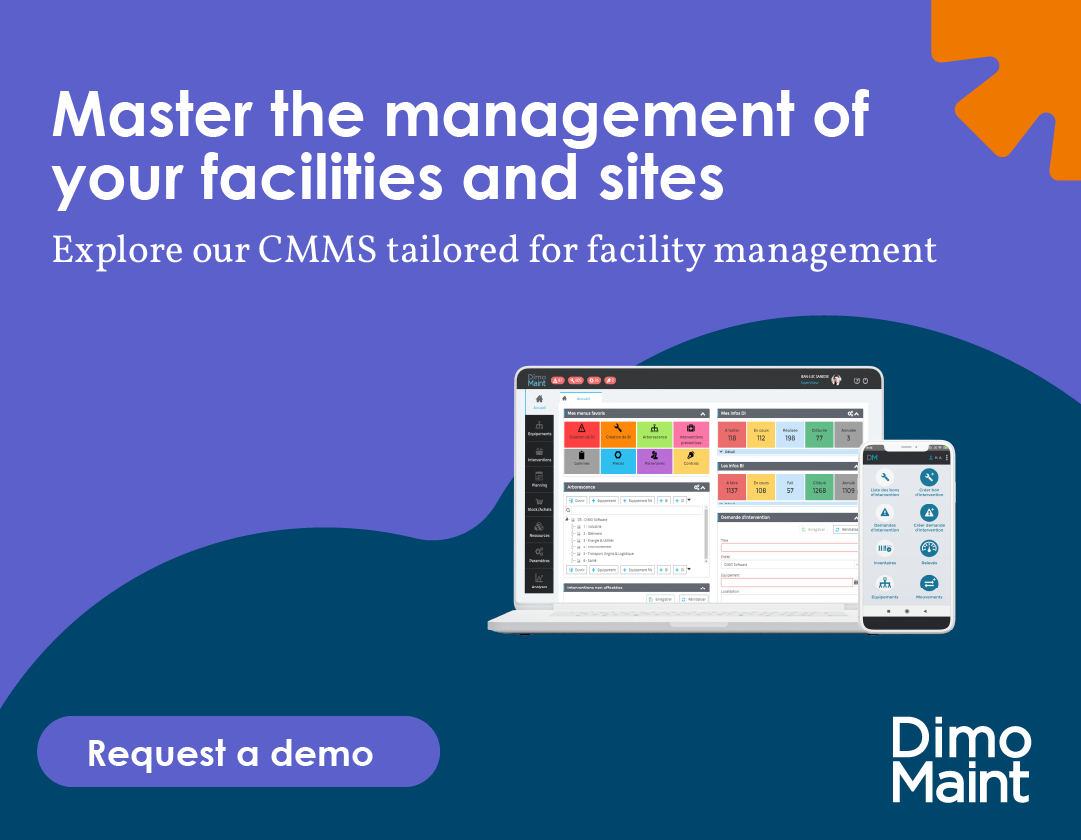
Entirely dedicated to Facility Management, DimoMaint FM brings together in one central tool a range of functions developed for commercial building management. Making it easy to manage one or more sites, the software addresses all the key aspects of facility management: cost reduction, operational excellence and regulatory compliance.
DimoMaint FM offers a full range of key features, including:
- Building and equipment management: the solution centralizes comprehensive data (technical documents, history, regulations) enabling the entire life cycle of one or more buildings to be monitored.
- Management of service providers and contracts: CAFM software facilitates the management of numerous subcontractors and guarantees perfect monitoring of legal documents (contracts, invoices, estimates)
- Communication: the software centralizes information exchanges and shortens validation processes
- Budget tracking: customized budgets can be defined by time period or by task. Quotations and invoices can be created directly by external service providers and entered into the tool.
- Customizable dashboards: our comprehensive reporting system integrates all the KPIs relevant to your organization and adapts to your users’ needs.
Key benefits of DimoMaint FM, a software solution designed specifically for the tertiary sector, include:
- Mobility and accessibility: usable over a simple Internet connection, DimoMaint FM can be used by anyone, from a computer or in the field.
- Adaptability: with 3 mobile applications for building managers, technicians and occupants, the solution adapts to its users.
- Interoperability: DimoMaint’s CAFM for the commercial sector integrates with existing information systems, taking advantage of building-specific data.
Comprehensive and easy to learn, DimoMaint FM makes facility management accessible to all organizations, and adapts to changes over time. Information is instantly available, and your facility management process becomes all the more agile.
Frequently Asked Questions (FAQs)
What are the main challenges of facilities management?
Facility Management faces a number of challenges, such as managing infrastructure maintenance, complying with safety regulations, optimizing energy efficiency, and adapting to technological change.
What can CMMS software do to improve facility management?
CMMS (Computerized Maintenance Management System) software can automate and simplify many facility management tasks. It enables centralized management of operations, better planning of maintenance tasks, and ensures full traceability.
What are the key criteria for choosing the right CAFM software for facility management?
The choice of a good CAFM software depends on several criteria: its ergonomics, its ability to integrate with other systems, the quality of its customer support, but also its specific functionalities, such as maintenance ticket management or predictive analysis.
In conclusion
The wide range of activities covered by Facility Management raises major challenges for managers. The key to success in organizing information is clarity.
Adopting a CAFM solution such as DimoMaint FM creates a more reliable property maintenance system, which will ultimately lead to a safer facility or building. CAFM makes it possible to anticipate and cross-reference information more effectively and coordinating activities with fluidity and agility results in a perfectly functional working environment.
Ready to optimize your Facility Management with our CAFM solution?