Sommaire
Every unplanned breakdown costs more than just repair time. It stalls entire production lines, delays orders, and erodes margins with no warning at all. For many facilities, this cycle repeats month after month with no end in sight.
The problem is not a lack of effort. It is a maintenance culture built around reacting to failures rather than preventing them. When only one team owns equipment care, problems slip through until something breaks.
Total productive maintenance TPM was built to solve exactly this. It is a company-wide strategy that puts equipment responsibility in the hands of every employee, from operators on the plant floor to managers in the back office. The result is fewer breakdowns, lower maintenance costs, and measurable gains in Overall Equipment Effectiveness (OEE).
If your facility is losing production hours to equipment failures, this guide covers how TPM works, what its eight pillars do, and how a CMMS helps you put it into practice.
Key Takeaways
- Total Productive Maintenance (TPM) is a company-wide maintenance strategy built around total productive maintenance TPM principles. It involves all employees, not just the maintenance team.
- TPM targets the Six Big Losses in production to improve Overall Equipment Effectiveness (OEE).
- The framework is built on eight interdependent pillars, including autonomous maintenance, planned maintenance, and preventive maintenance.
- A CMMS supports TPM by centralizing maintenance data, automating work orders, and tracking equipment performance in real time.
What Is Total Productive Maintenance (TPM)?
Total Productive Maintenance (TPM) is a maintenance management approach that puts equipment reliability in the hands of the entire organization. Unlike traditional models where only dedicated maintenance teams handle repairs, TPM gives operators, engineers, and administrators shared responsibility for equipment care.
The approach was developed by Seiichi Nakajima at the Japan Institute of Plant Maintenance in 1971, drawing from the Kaizen philosophy of continuous improvement and lean manufacturing principles. TPM principles focus on eliminating waste from production processes: equipment breakdowns, speed losses, quality defects, and more.
Full productive maintenance TPM implementation typically takes two to three years to reach maturity. Organizations that commit to the process see measurable gains in equipment efficiency, product quality, and operational safety.
What Are the Main Objectives of Total Productive Maintenance?
TPM focuses on one central metric: Overall Equipment Effectiveness (OEE). OEE measures how well equipment is used by combining three factors: availability, performance, and quality. Maximizing equipment effectiveness means reducing or eliminating the Six Big Losses that drag OEE down:
- Unexpected failures: sudden breakdowns that halt production
- Setup and adjustment losses: downtime during changeovers
- Minor stoppages: short pauses under 10 minutes that add up fast
- Speed losses: equipment running below its designed capacity
- Quality defects: output that fails standards due to poor equipment condition
- Capital depreciation losses: assets degrading faster due to poor maintenance practices
Reaching zero losses is the goal. Getting close to it means stronger OEE, lower costs, and more reliable output.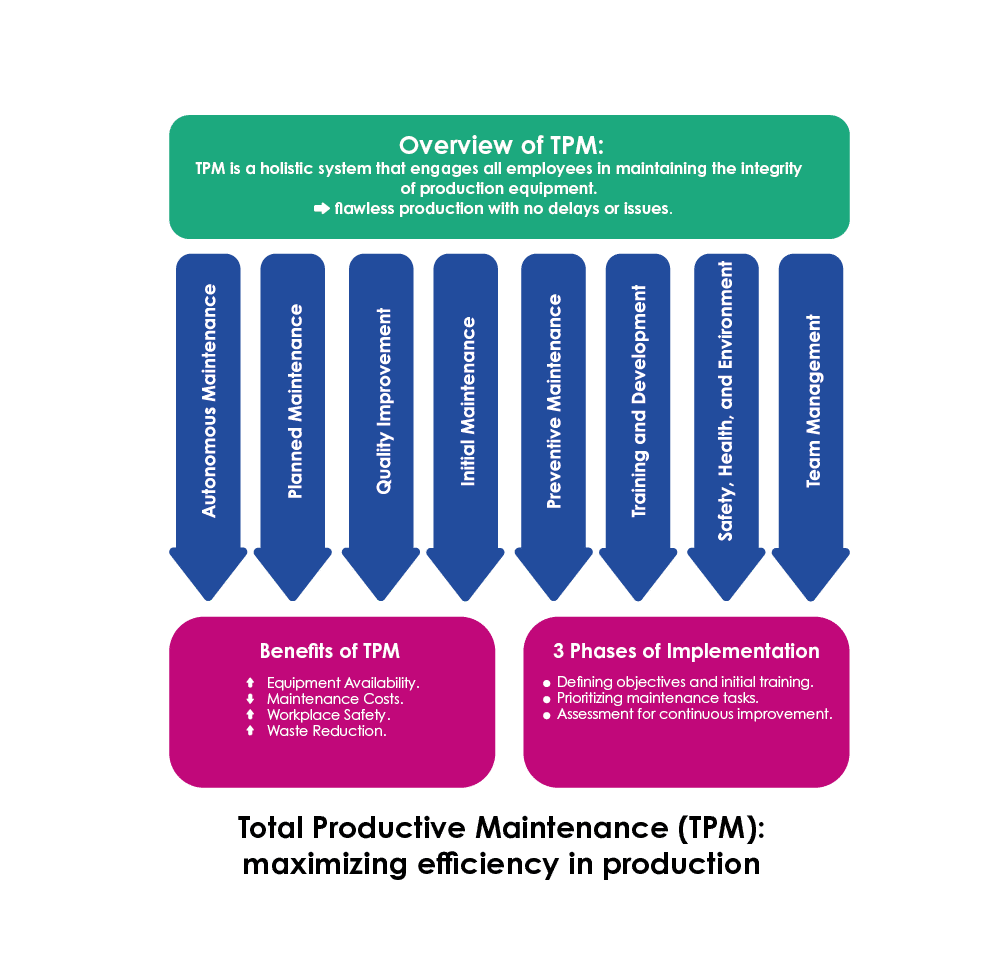
What Are the Benefits of Total Productive Maintenance?
How does TPM improve equipment availability and reliability?
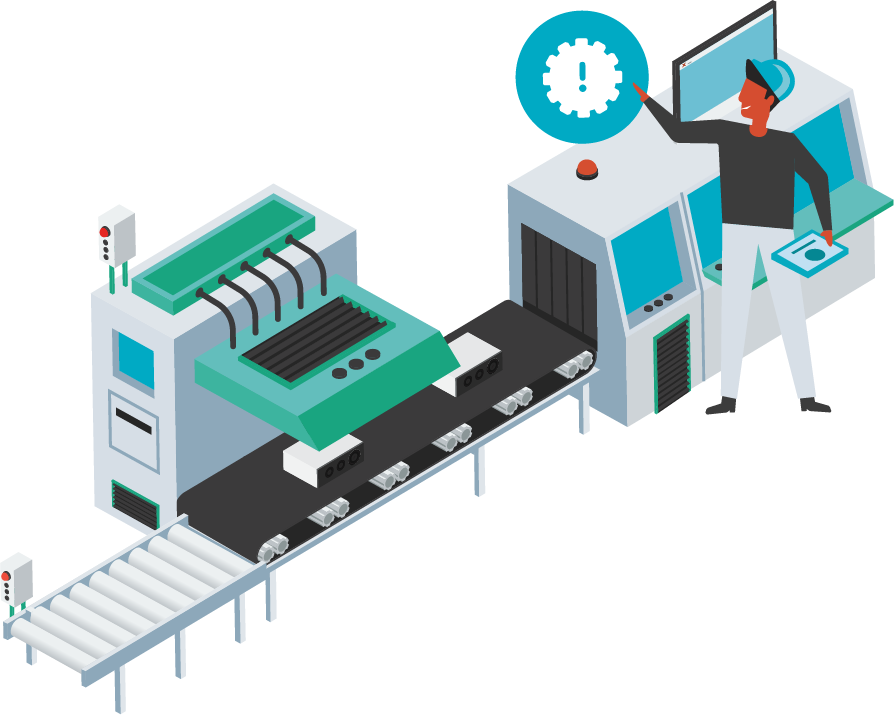
TPM keeps machines in consistent operating condition by distributing basic maintenance tasks to operators. Through an autonomous maintenance program, operators handle routine maintenance like cleaning, inspection, and lubrication on a regular schedule. This reduces the load on maintenance staff, helps ensure equipment availability, and frees technicians to focus on higher-impact work.
When equipment runs reliably, teams improve productivity without adding resources. Fewer unplanned stoppages mean more time on actual output.
Does TPM lower maintenance costs?
When equipment failures are caught early through proactive maintenance techniques, repairs cost less. Unplanned downtime is replaced by scheduled maintenance, which is far less disruptive to production.
According to McKinsey and Company, shifting from reactive to predictive maintenance can reduce maintenance costs by 10 to 40% and cut unplanned downtime by up to 50% in manufacturing environments.
What is TPM’s impact on quality and safety?
Machines in poor condition produce inconsistent output. TPM’s quality maintenance pillar directly ties equipment upkeep to defect reduction. When equipment operates within spec, quality problems decrease.
On safety, a clean and well-maintained machine environment reduces the conditions that cause accidents. OSHA notes that hazards can be introduced over time when maintenance is neglected or equipment becomes worn. TPM’s Safety, Health, and Environment (SHE) pillar builds safety into every other pillar from the start.
Looking to reduce unplanned downtime and improve OEE in your facility? Speak with a DimoMaint specialist to find the right maintenance strategy for your operation.
The Eight Pillars of Total Productive Maintenance
The eight pillars of TPM are interdependent. Skipping one weakens the whole system. Here is what each covers.
Pillar 1: Autonomous Maintenance
Autonomous maintenance transfers basic maintenance tasks from maintenance staff to equipment operators. Operators who work with machines daily are best placed to spot early warning signs of wear or failure.
A clear autonomous maintenance plan gives each operator defined responsibilities. An autonomous maintenance checklist then turns that plan into a daily routine, keeping equipment in good condition between formal maintenance visits and building ownership on the plant floor.
Pillar 2: Planned Maintenance

Planned maintenance schedules service at the right times to reduce disruption. Maintenance teams track each asset’s lifespan and maintenance intervals, using downtime or off-peak periods for scheduled work.
A structured planned maintenance schedule cuts emergency repairs and makes costs more predictable. A CMMS is essential here: it automates work orders, tracks maintenance history, and flags assets before failures occur.
Pillar 3: Quality Maintenance
Quality maintenance links equipment condition directly to product quality. This pillar uses root cause analysis to find which equipment failures cause defects, then fixes them at the source. It works alongside broader quality management processes to ensure production output stays consistent.
OEE is the core measurement. When equipment runs properly, defect rates fall in proportion to improvements in upkeep.
Pillar 4: Early Equipment Management (EEM)
Early Equipment Management (EEM) applies maintenance thinking during equipment design and acquisition. Before new manufacturing equipment enters the plant, maintenance personnel assess it against TPM goals. The aim is maintenance prevention: designing reliability in from the start rather than correcting problems later.
EEM uses data from existing production systems to guide decisions on new ones. This reduces lifecycle costs and prevents failures from being built into equipment from the start.
Pillar 5: Preventive Maintenance
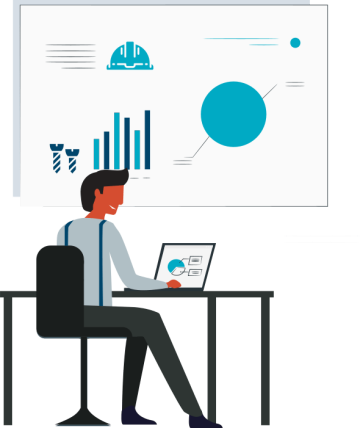
Preventive maintenance addresses equipment before issues arise. It includes time-based scheduled maintenance, condition-based maintenance, and predictive maintenance using real-time performance data. This is different from corrective maintenance, which only responds after a failure has already occurred.
Focused improvement complements this pillar by targeting recurring failures or performance losses with structured problem-solving. Together, they shift maintenance teams from reactive response to proactive control.
Pillar 6: Training and Development
All employees need to understand their role in TPM. Operators need training on autonomous maintenance routines. Maintenance staff need skills in planned and predictive maintenance techniques. Leadership needs to understand what sustaining TPM requires.
Training operators is not a one-time event. Consistent skill development keeps TPM practices stable across shifts, departments, and personnel changes.
Pillar 7: Safety, Health, and Environment (SHE)
Well-maintained equipment creates a safer workplace. Fewer breakdowns mean fewer hazardous conditions. Better equipment efficiency also reduces energy use and waste per unit of output.
SHE ensures that safety and environmental issues are addressed within every other pillar, not managed as a separate program. This is what makes safety in a TPM environment structural rather than reactive.
Pillar 8: Administrative TPM
TPM extends to administrative functions. Order processing, procurement, and workforce scheduling all affect production efficiency. Applying continuous improvement thinking to these processes reduces delays that slow down the plant floor.
Improving operational efficiency in back-office workflows directly supports the maintenance system on the production side. Bottlenecks in administration create real friction for maintenance planning and equipment operation.
Want help structuring a TPM program across all eight pillars? Contact DimoMaint to speak with a maintenance management specialist.
How Is Total Productive Maintenance Implemented?
Implementing Total Productive Maintenance follows a structured three-phase process. According to a peer-reviewed study published in MDPI’s Encyclopedia journal, the typical TPM project timeline is three years, depending on the size and complexity of the organization. A successful TPM implementation requires clear goals, cross-functional buy-in, and the right tools to support each phase. Below is how each phase of a total productive maintenance program unfolds in practice.
Phase 1: Preparation
Set clear objectives based on your current OEE baseline, your main sources of unplanned downtime, and your team’s existing capabilities. Introduce TPM concepts through company-wide training and run a pilot area first to show results before full rollout.
The 5S methodology (Sort, Set in Order, Shine, Standardize, Sustain) is the foundation here. TPM cannot succeed without a clean, organized, and standardized work environment as its base.
Phase 2: Start-Up
List all known breakdowns, backlogged repairs, and pending maintenance tasks. Prioritize the most urgent and restore equipment to prime operating condition before anything else.
Once backlogs are cleared, launch your planned maintenance schedule. Assign autonomous maintenance routines to operators. Set your OEE baseline so you can track real progress from the start.
Phase 3: Consolidation
With preventive maintenance running, the focus shifts to monitoring and improving. Review maintenance processes regularly. Use root cause analysis when failures occur to fix underlying causes, not just symptoms.
This is the phase where the TPM process becomes a lasting culture rather than a project. Leadership engagement is critical: without it, early gains tend to erode.
How Does a CMMS Support Total Productive Maintenance?
A Computerized Maintenance Management System (CMMS) does not replace TPM. It makes TPM executable at scale. Here is what it handles:
-
- Maintenance data in one place: full asset history, failure logs, and work records
- Automated preventive maintenance: work orders triggered by schedule or equipment condition
- OEE tracking: real-time visibility into availability, performance, and quality
- Autonomous maintenance support: digital checklists for operators, accessible via mobile on the plant floor
- Maintenance planning tools: forecast labor, parts, and budget needs with accuracy
Without a CMMS, plant maintenance relies on spreadsheets and manual coordination. At scale, that breaks down. A centralized maintenance system gives teams the data they need to apply proactive and preventive techniques consistently, rather than defaulting to reactive repairs.
DimoMaint MX is a SaaS CMMS built for teams running TPM programs. Request a demo to see how it supports your maintenance strategy.
FAQ: Total Productive Maintenance (TPM)
What is Total Productive Maintenance (TPM)?
Total Productive Maintenance (TPM) is a maintenance management approach that involves all employees in preserving equipment reliability and availability. It uses eight structured pillars to prevent failures, reduce unplanned downtime, and improve OEE across production processes.
What are the main objectives of TPM in industry?
TPM’s primary goal is to eliminate the Six Big Losses: breakdowns, setup losses, minor stoppages, speed losses, quality defects, and capital depreciation. This improves OEE, reduces maintenance costs, and builds a continuous improvement culture across the organization.
What are the eight pillars of TPM?
The eight pillars are: autonomous maintenance, planned maintenance, quality maintenance, early equipment management, preventive maintenance, training and development, safety/health/environment, and administrative TPM. They are interdependent and must work together.
How long does TPM implementation take?
Full TPM implementation typically takes two to three years to reach maturity. Measurable gains in OEE and unplanned downtime often appear within the first six to twelve months, especially after equipment is restored and the maintenance schedule is running.
What role does a CMMS play in a TPM strategy?
A CMMS supports TPM by centralizing maintenance data, automating scheduled maintenance tasks, and tracking equipment performance metrics like OEE. It gives maintenance teams the visibility they need to act proactively, not reactively.
Ready to move from reactive to proactive maintenance? Contact the DimoMaint team to find out how DimoMaint MX supports your TPM implementation.