Confectionery industry: reducing unplanned stoppages through structured, well-equipped maintenance
In the food industry for sweet products, unplanned production stoppages have an immediate impact on line availability and product quality. They most often occur on assets and in situations already known to the teams. Understanding why these stoppages repeat is a prerequisite for any structured maintenance approach.
Production stoppages in the confectionery industry: known causes but poor management
Recurring failures on sensitive assets
Despite the variety of productions (biscuit, chocolate, confectionery), unplanned stoppages generally concentrate on a few well-identified problem families:
- Thermal deviations on ovens, tempering units, cooling tunnels or enrobing machines, causing product non-conformities or stoppages for adjustment.
- Build-up from sugar, fats and chocolate, causing jams, loss of synchronization and mechanical blockages.
- Accelerated mechanical wear of chains, bearings, gearboxes and conveyors, due to high throughputs.
- Packaging malfunctions, often linked to setup or feeding defects, with repeated micro-stops.
These failures are rarely unpredictable. They develop progressively and usually give signals before the stoppage.

Why these stoppages keep recurring
If the causes are known, their treatment often remains insufficient over the long term:

- Breakdowns are handled as emergencies, then quickly forgotten once the line restarts.
- Adjustments and corrective actions are not always formalized or shared between teams.
- The lack of a structured history prevents identifying truly recurring failures.
- Priorities are set without a clear view of the cumulative impact of stoppages on line availability.
Without consolidated data, maintenance remains largely reactive. Incidents recur, not from a lack of skill, but due to a lack of data-driven management.
Structuring effective preventive maintenance to reduce unplanned stoppages
After observing that stoppages repeat despite field experience, the challenge becomes organizational. Reducing unplanned stoppages sustainably requires a preventive maintenance built on clear priorities, plans adapted to industrial realities and more reliable interventions.
Identify and prioritize truly critical assets
The first step is to evaluate the real criticality of assets across several dimensions:
- Impact on production: complete line stoppage, loss of throughput, product rejects.
- Impact on quality and hygiene: non-conformities, downgrades, intensified cleaning.
- History of stoppages and failures: frequency, cumulative downtime, recurrence of the same symptoms.
- Contribution to TRS: assets causing significant availability or performance losses.
This prioritization makes it possible to move away from uniform maintenance and to concentrate efforts where the return is most measurable.
Build maintenance plans tailored to real constraints
An effective preventive plan in a sweet-products environment cannot be standardized without accounting for constraints; intervention frequencies must be adjusted:
- to high throughputs and frequent format changes,
- to the nature of the products (dry sugar, chocolate, fatty products),
- to thermal and humidity conditions.
Integrating cleaning operations into maintenance plans is also decisive. In the confectionery industry, build-up is both a reliability and compliance issue. Cleaning, inspection and maintenance must be planned together, not as separate activities.
Finally, hygiene and quality requirements must be integrated from the design of maintenance procedures: access to sensitive areas, controlled disassembly, systematic post-intervention checks.
Standardize interventions to secure settings and reduce MTTR
Standardizing interventions aims to secure settings and reduce downtime.
This includes:
- clear, documented intervention procedures that are usable in the field,
- reference settings available to technicians during interventions,
- systematic post-intervention checks to ensure return to nominal condition.
This approach limits setup errors, improves the reproducibility of interventions and helps reduce MTTR during inevitable incidents. Maintenance thus gains robustness and predictability, even with team rotation or increased production load.
Organize maintenance to sustainably move away from emergency mode
- Move from corrective to planned maintenance: distinguish real emergencies from schedulable requests, align maintenance with scheduled production stoppages and anticipate recurring interventions.
- Better coordinate maintenance, production and quality: effective coordination depends on shared, reliable information.
- Manage costs and resources factually: maintenance is still too often seen as a cost centre. Managing time, costs per asset and the real impact of stoppages helps change this perception. Maintenance becomes a full contributor to industrial performance.
Move from preventive maintenance to predictive maintenance

When preventive maintenance is structured and the organization gains stability, using data enables further anticipation of failures.
Predictive maintenance can be relevant for the most penalizing assets. Deployed progressively, it complements existing preventive measures without overburdening field practices. It identifies weak signals (repeated micro-stops, performance drifts, abnormal part consumption) to trigger interventions before major stoppages.
The central role of the CMMS
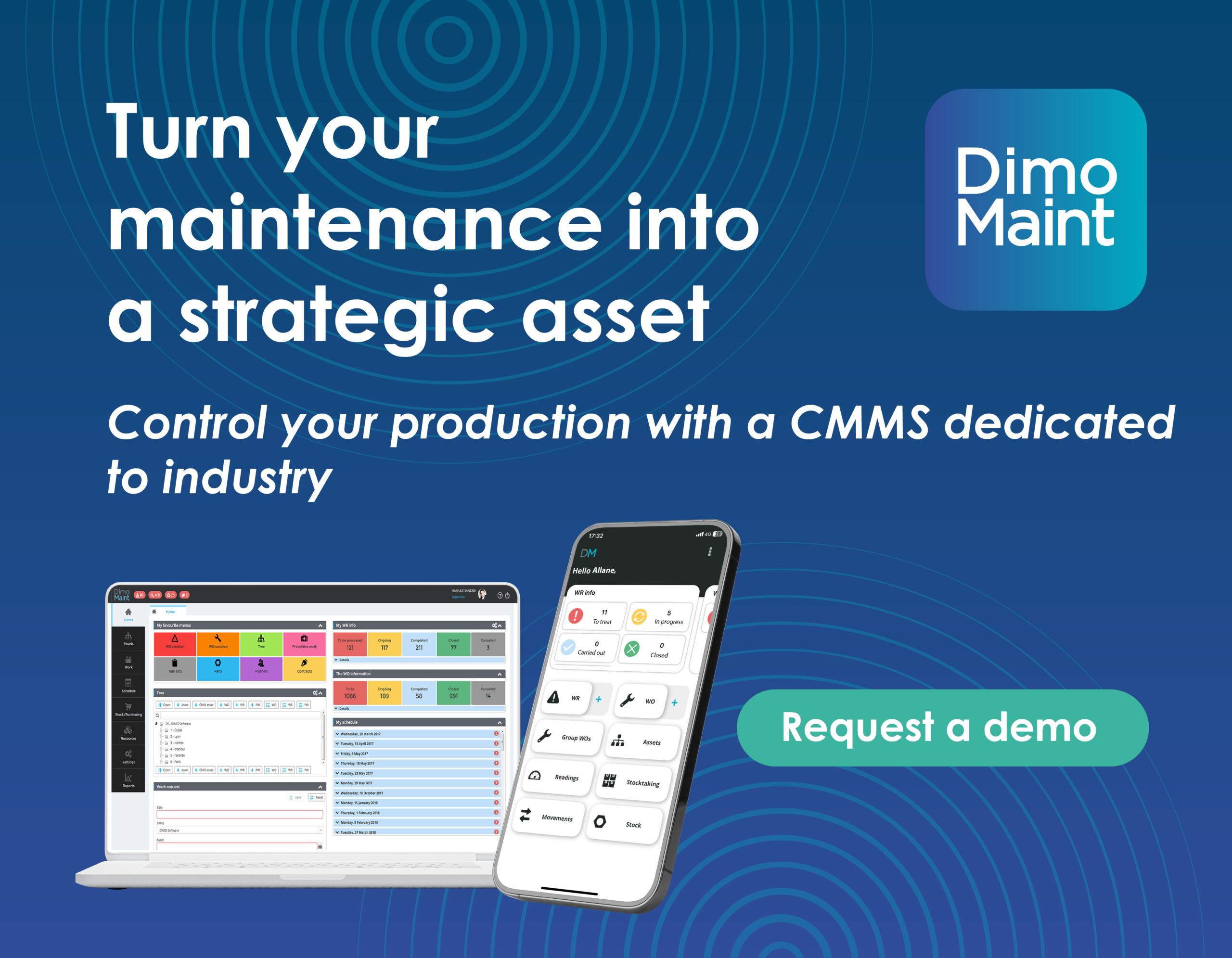
The CMMS (Computerized Maintenance Management System) is the management system for structured maintenance. It enables centralizing, securing and exploiting all the data necessary to reduce unplanned stoppages.
“The CMMS allowed us to replace scattered Excel files with a single tool shared across teams, giving clear visibility over interventions and assets.”
— Maintenance Manager, Léonidas
The CMMS specifically enables:
- Centralizing maintenance data: failures, interventions, parts, downtime,
- Creating a preventive maintenance plan and structuring intervention scheduling,
- Analyzing failure causes and their recurrence,
- Supporting decisions with factual data.
“The need for finer work management became apparent, as well as the need to better structure preventive maintenance and intervention planning.”
— Maintenance Manager, Sucrerie Gardel
The CMMS aggregates all information related to assets and interventions:
- Maintenance history by asset,
- Asset records and technical data,
- Failure reports and failure modes,
- Performance and availability indicators.
This centralization makes it easier to identify root causes, prioritize high-impact actions and manage overall line reliability.
Using the CMMS on the shop floor strengthens maintenance teams’ effectiveness. This traceability also simplifies the preparation and conduct of quality and hygiene audits, while ensuring installation compliance.
“Centralizing maintenance data allowed us to make failure tracking reliable and to have a clear view of asset availability.”
— Maintenance Manager, Moulin du Pivert
In the confectionery industry, unplanned stoppages are frequent but seldom unpredictable. Their sustainable reduction relies on a logical progression: structure preventive maintenance, organize maintenance, then use data to anticipate failures.
Supported by a CMMS adapted to food industry constraints, such as DimoMaint, maintenance becomes a lever for reliability, performance and compliance.