
Sommaire
Several facilities, several teams, sometimes several tools and different maintenance practices. At the scale of a GHT or a multisite healthcare organization, the challenge is not only to centralize: you must build common rules without losing the knowledge and constraints specific to each facility.
So, where to start to harmonize the maintenance of biomedical assets?
Key takeaways
- To harmonize biomedical maintenance, define a common foundation while keeping the necessary adaptations to each facility’s realities.
- A shared reference framework is the starting point for a multisite organization: nomenclatures, asset families, manufacturers, models and statuses must be coherent enough to consolidate and use data at the GHT level.
- Practices and indicators should be aligned progressively: compare maintenance methods and define KPIs according to common rules.
- A multisite CMMS can serve as a common foundation, but the tool alone is not enough: data sharing must be accompanied by work on nomenclatures, procedures, data quality and responsibilities.
Why harmonize biomedical maintenance across multiple facilities?
Groupements hospitaliers de territoire (GHT) are based on a cooperation model between public healthcare institutions. In France, 136 GHTs have been formed, with very different configurations: they group from 2 to 20 facilities depending on the territory. This organization notably increases the challenges of maintenance of biomedical assets across multiple sites.
This cooperation logic specifically concerns some support functions and medico-technical activities. A circular published in July 2026 also encourages GHTs to strengthen pooling and integration between facilities, while taking into account their maturity level and organization.
For biomedical teams, this organization quickly raises very concrete questions.
- Do two facilities use the same nomenclature to name an asset?
- Do they apply the same preventive maintenance procedures?
- How to share history when equipment changes site?
- Are indicators calculated the same way?
- How to get a territory-level view of the fleet without losing local detail?
- Etc.
1. Start by speaking the same language
The first task is to look at how assets are described in each facility.
The same type of medical device can be named, classified or coded differently depending on the sites. At a small scale, these differences may seem minor. They become much more problematic when you need to consolidate several thousand assets.
It then becomes difficult to answer questions that should be simple: how many assets do we have in this family? On which sites? Which brands? What are their statuses? What contracts or maintenance terms are associated with them?
Creating a shared reference framework helps bring data closer together: asset families, categories, manufacturers, models, statuses and information needed for maintenance follow-up.
This issue of data standardization does not only concern the biomedical field. In hospital procurement, the Ministry of Health highlights that harmonizing nomenclatures improves data reliability at the GHT level and enables common analyses.
For the biomedical fleet, the principle is similar: before consolidating, ensure that facilities are indeed talking about the same thing.
2. Build a common maintenance foundation without making everything uniform
Once the fleet is better structured, a more delicate question arises: should the exact same maintenance policy be applied everywhere?
Some principles can be common: traceability rules, data structure, work management, monitoring methods, indicators or shared procedures for certain asset families.
But local realities remain different. An asset may be abundant on one site and much rarer on another. Available technical skills may vary. Maintenance contracts are not always identical. Service organizations and operational constraints can also differ.
Harmonization is therefore more about defining a common framework than imposing a strictly identical organization on all facilities.
This distinction is important in GHTs. The ministry itself reminds that facilities can build pooling arrangements adapted to their territory and that some activities can keep a local organization while fitting into a common logic.
3. Harmonize maintenance policies progressively
For the same asset family, teams can compare their methods: which operations are performed? At what frequency? By whom? What checks are carried out? Is preventive maintenance performed in-house, by the manufacturer or by a contractor?
The first benefit of this comparison is to make differences in practice visible, then determine which practices can realistically be aligned.
Field feedback: a common policy built step by step
The experience feedback from Chartres Hospitals concretely illustrates this gradual approach. As the lead facility of GHT 28, the hospital center must organize maintenance for 56 buildings across three sites.
Before deploying the CMMS, teams engaged in several structuring projects: creation of a common nomenclature, inventory of assets and locations, data migration and reorganization of maintenance plans. This work notably allowed the preventive maintenance library to be rationalized, reduced from nearly 1,000 plans to 170.
Although this feedback mainly concerns technical hospital maintenance, it highlights a principle also applicable to biomedical maintenance: harmonization starts with a reliable reference framework and shared rules.
Convergence therefore does not need to cover the entire fleet immediately. An asset family common to several facilities can form a first scope of work before gradually extending the approach.
4. Give teams a local view… and a multisite view
The biomedical manager or coordination team may need a consolidated view to compare facilities, identify trends or allocate resources.
An effective multisite organization must therefore allow navigation between several levels:
|
Level |
Useful information |
|
Asset |
History, interventions, documents, condition |
|
Department / site |
Fleet, ongoing interventions, preventive maintenance |
|
Facility |
Activity, availability, costs, indicators |
|
GHT / multisite organization |
Fleet consolidation, site comparison, trends and governance |
This ability to share information between facilities is part of the broader convergence logic promoted by GHTs. In the field of information systems, the ministry notably presents shared access to information and the use of homogeneous tools as levers for activity pooling.

5. Define indicators that are truly comparable
A multisite dashboard is only valuable if the data it compares are based on common definitions.
Take an apparently simple indicator: the number of breakdowns.
Does one facility record a breakdown at every work request? Another only when a technical failure is confirmed? The two figures then become difficult to compare.
Before multiplying KPIs, it is better to precisely define what each party measures.
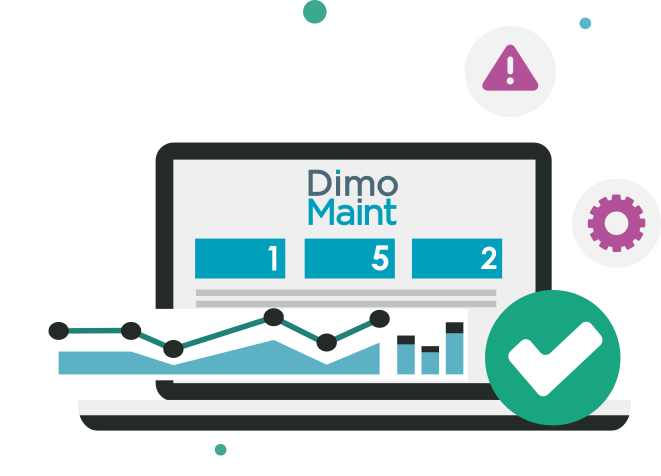
Some maintenance indicators can then be tracked at multiple levels: preventive compliance, intervention volume, response times, downtime, recurrence of breakdowns, costs or asset availability.
Why does the same asset family generate more interventions on one site? Why do downtime durations differ? Does a local practice yield better results and could it be shared?
The dashboard thus becomes a tool for dialogue between teams.
6. Pool resources where it really adds value
Once data and practices are made comparable, some pooling opportunities become easier to study.
Fleet consolidation can, for example, reveal several facilities using the same asset families or models. This visibility can feed reflection on maintenance contracts, external services, available skills or certain purchases.
Procurement pooling is already a structured function at the GHT level.
The ministry notably states that this organization should enable partnership work between facilities and a convergence of markets. The July 2026 circular goes further towards strengthening pooling within GHTs and encourages seeking a better allocation of available resources.
For biomedical maintenance, the challenge remains to pool what benefits from pooling, without distancing skills and resources from the operational needs of services.
7. A multisite CMMS to share the same reference framework
When each facility keeps its own files, nomenclatures or tools, obtaining a consolidated view of the fleet quickly becomes complex.
A CMMS adapted to healthcare facilities and to a multisite organization can form the common foundation to share an asset reference framework, management rules and indicators, while keeping rights, views and organizations adapted to each facility.
It can notably facilitate tracking the fleet by site, centralizing histories, scheduling maintenance operations or consolidating the data needed for governance.
But installing a common tool is not enough to harmonize practices.
Work on nomenclatures, procedures, data quality and responsibilities must accompany the project. Otherwise, the risk is simply to gather different practices within the same system.
For healthcare facilities, GHTs and multisite organizations that wish to structure the tracking of their assets and maintenance, DimoMaint offers CMMS software adapted to the needs of healthcare facilities and biomedical teams.
The success of a multisite approach is measured by teams’ ability to share the same language, access reliable data, apply a common foundation and clearly identify situations that require local adaptation.
For a GHT, the approach can therefore progress step by step: start by securing the asset reference framework, compare practices on a few asset families, define common indicators, then extend what works.
The goal is not to make all facilities work in exactly the same way, but to enable them to work better together.
Partager cet article


