
Sommaire
Fire safety, elevators, electrical installations, domestic hot water networks… In EHPADs, regulatory checks cover very different installations, with periods and requirements that are not always the same.
For technical teams, the challenge is therefore not only to have checks carried out. They must also know which ones apply, anticipate deadlines, handle observations and keep proof of what has been done.
DimoMaint offers CMMS solutions for healthcare and medico-social facilities to structure the tracking of assets, interventions and maintenance operations.
Key takeaways
- Variable obligations: regulatory checks depend on the classification of the EHPAD and its installations.
- Sensitive assets: fire safety, elevators, electrical installations and domestic hot water networks require adapted monitoring.
- Essential traceability: each check must be linked to a deadline, a report and, if necessary, a corrective action.
- Anticipating deadlines: centralized planning helps reduce oversights and emergency interventions.
- The role of the CMMS: it facilitates planning, tracking anomalies and keeping evidence, but it does not alone guarantee compliance.
Which regulatory checks should be monitored in an EHPAD?
Not all EHPADs have exactly the same technical scope. Obligations depend in particular on the building, the installed assets and the facility’s regulatory classification.
For fire safety, facilities housing elderly people with reduced autonomy may be classified as type J according to the criteria defined by the ERP safety regulations. This classification takes into account capacity and the residents’ level of dependence.
The technical manager may therefore need to monitor several families of installations:
|
Domain |
Examples of checks |
|
Fire safety |
fire safety system (SSI), detection, compartmentation, smoke extraction, emergency lighting |
|
Elevators |
maintenance, technical inspection, observations |
|
Domestic hot water |
temperatures, legionella analyses |
|
Electrical installations |
applicable verifications, reports, resolution of observations |
|
Heating / ventilation |
regulatory or contractual operations depending on the installations |
|
Service contracts |
mandatory visits, services, upcoming deadlines |
This list is not an exhaustive regulatory inventory. The right approach is to start from the installations actually present in the facility, then identify for each the applicable texts, contracts and verifications.
1. Fire safety: a particularly sensitive issue in EHPADs
Fire safety has a specific issue in EHPADs: some residents can be difficult to evacuate quickly.
The regulation applicable to type J establishments is based in particular on a logic of horizontal transfer of residents to a protected area, rather than immediate full-building evacuation.
For concerned facilities, the text provides notably for a category A fire safety system and automatic fire detection in the building, with the exceptions provided by the regulation.
For the maintenance service, this means being able to link:
asset → maintenance operation or verification → report → possible observation → corrective action.
Compliance does not rely solely on equipment. Staff assigned to monitoring must also be trained in the required procedures and, in concerned facilities, practical drills must be organised at least once every six months.
In short, regulatory monitoring combines technical, organisational and traceability aspects.
2. Legionella: monitoring the domestic hot water network over time
Domestic hot water networks are another point of vigilance for medico-social facilities.
Monitoring is based on temperature measurements and legionella analyses. For concerned medico-social facilities, the minimum frequencies include in particular:
- a monthly temperature measurement at certain points of the network (production outlet, points of use and return loop according to the configuration);
- an annual legionella analysis in the relevant tanks;
- an annual analysis at certain representative or remote points of use;
- monitoring of the return loop where it exists.
Again, the real difficulty for the technical manager is not only knowing the frequency.
They must be able to answer five questions quickly:
Where? When? By whom? With what result? What action was taken in case of deviation?

The analysis report must also identify the sample precisely, including the facility, date and time of sampling, water temperature and location of the sampling point.
It is this continuity of information that allows moving from a one-off check to genuine monitoring.
3. Elevators: don’t confuse maintenance with regulatory inspection
In an EHPAD, elevators are particularly sensitive due to the movements of residents, staff and equipment.
But two notions must be distinguished: the maintenance of the installation and its regulatory technical inspection.
Inspections aims in particular to verify safety devices and to spot defects that could be dangerous for people or compromise the equipment’s operation.
Type J ERPs also have specific requirements for elevator use in case of fire, notably that cabins must not stop in the affected zone.
For maintenance, the consequence is simple: a form titled “elevator checked” is not enough.
It is necessary to distinguish:
- maintenance operations;
- the technical inspection;
- verifications related to safety equipment;
- observations raised;
- corrective actions still open.
4. How to organise tracking of regulatory deadlines?
The main operational risk often stems less from a lack of information than from its dispersion.
A report arrives by email. A contract is stored on a server. The next visit is in a technician’s calendar. An observation is noted in an Excel sheet.
Each element exists, but no one has a complete view.
A simple method is to create a tracking reference for each installation:
|
Information |
What to record |
|
Installation |
SSI, elevator, DHW network… |
|
Location |
building, floor, zone |
|
Type of operation |
maintenance, check, analysis, verification |
|
Applicable reference |
text, contract or procedure |
|
Last completion |
date |
|
Next deadline |
scheduled date |
|
Responsible |
internal team or provider |
|
Document |
report, certificate, minutes |
|
Observation |
reserve or anomaly noted |
|
Corrective action |
to be started / in progress / closed |
The objective is not to create one more spreadsheet, but to be able to answer three questions immediately:
What needs to be done? When? And how to prove it has been done?

5. What to do when a regulatory check finds an anomaly?
A completed check does not mean the file is closed.
A report may contain an observation, a reservation or a non-conformity. If that information remains locked in an archived PDF, the check has not yet produced all its operational value.
The process must go through to correction:
Inspection → report → observation → intervention → verification → closure

The technical service must therefore be able to convert an observation into a maintenance action, assign a responsible person, track its progress and keep proof of its resolution.
This step is decisive for compliance: it is not enough to prove that the check took place; you must also be able to trace the follow-up given to detected anomalies.
6. Anticipate rather than manage checks in urgency
A regulatory deadline known several months in advance is relatively simple to organise.
The same deadline discovered a few days before becomes much more constraining: finding an available provider, making the installation accessible, retrieving the last report, checking that previous anomalies are closed…
Tracking must therefore enable anticipation of:
- upcoming visits;
- providers to contact;
- the assets concerned;
- required documents;
- observations still open.
In a group of EHPADs or a multisite organisation, this visibility becomes even more important: frequencies may be identical, but dates, contracts and installations differ from one facility to another.
7. How does a CMMS help track compliance in EHPADs?
A CMMS can link in the same environment the installation, preventive operations, checks, documents and corrective actions.
It can, for example, allow you to:
- schedule a recurring intervention;
- trigger alerts before a deadline;
- associate a contract or a provider with an installation;
- attach an inspection report to the relevant asset;
- turn an observation into an intervention;
- keep a history of actions performed.
However, it must be precise: a CMMS does not make an EHPAD compliant by itself. It helps teams organise, trace and document the necessary actions; compliance still depends on the applicable obligations and their effective implementation.
Depending on the facility’s needs, tracking can rely on a CMMS dedicated to building technical management, like DimoMaint FM, or on a SaaS CMMS for asset management, like DimoMaint MX.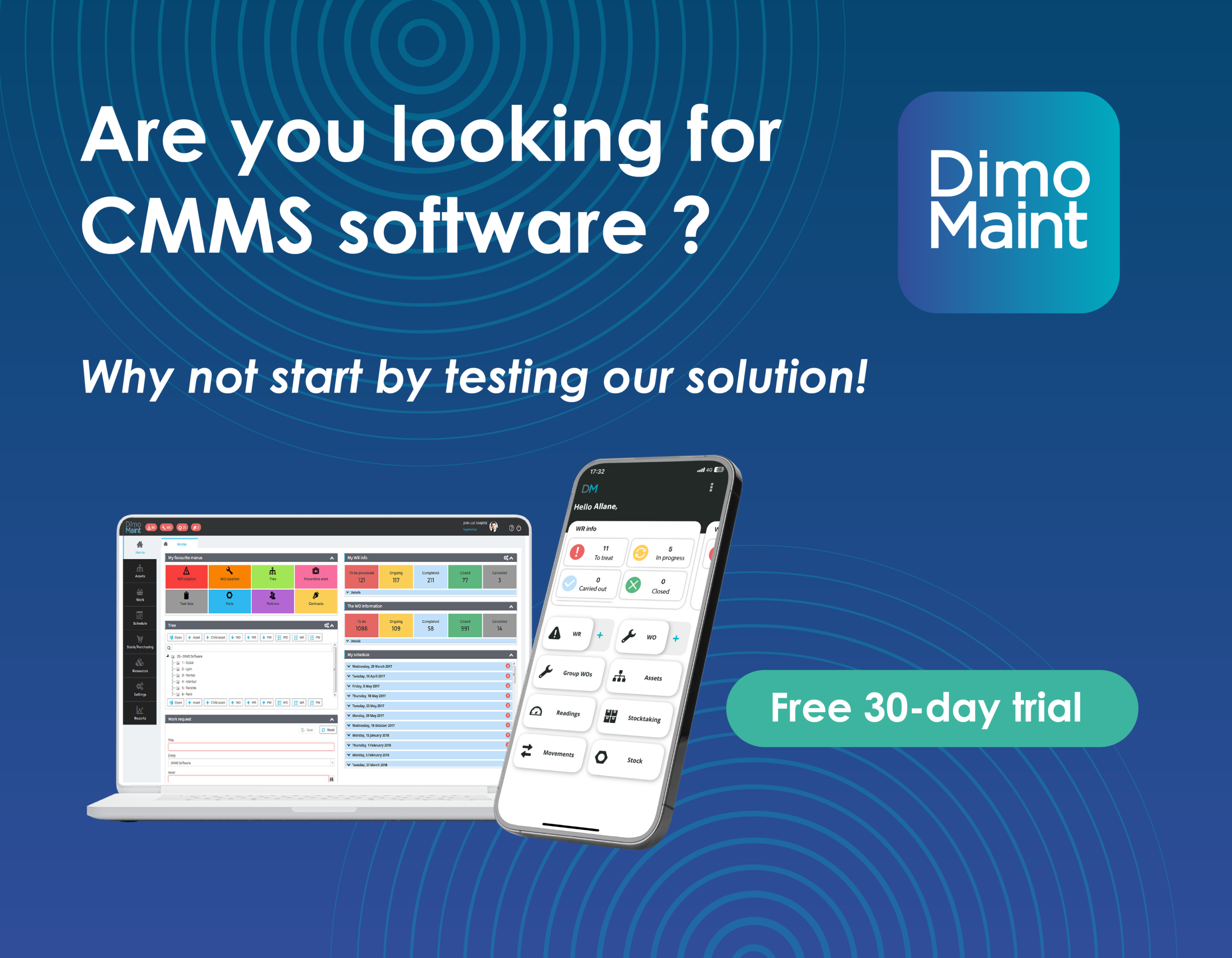
Partager cet article


